B2M and HLA-A2.1 Protein Expression Analysis
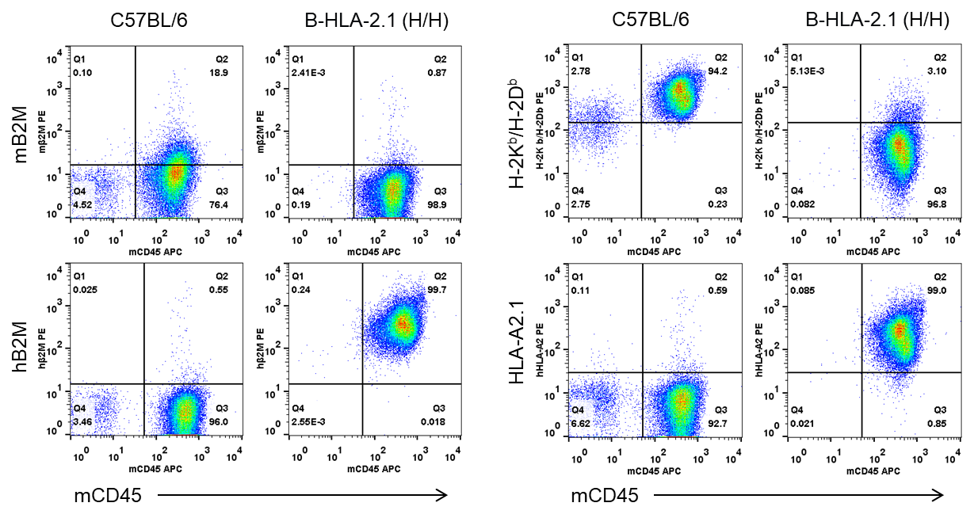
- Mouse B2M and H-2Kb/H-2Db were detected exclusively in wild-type C57BL/6N mice, but not in homozygous B-HLA-A2.1 mice.
- Human B2M and HLA-A2.1 were exclusively detected in homozygous B-HLA-A2.1 mice.
Strain specific B2M and HLA expression analysis in homozygous B-HLA-A2.1 mice by flow cytometry. Splenocytes from both wild-type C57BL/6N (+/+) and homozygous B-HLA-A2.1 mice (H/H) were analyzed by flow cytometry. B2M expression was analyzed by flow cytometry using species-specific anti-mouse B2M antibody (Biolegend, 154503) and anti-human B2M (Biolegend, 316305). HLA expression was analyzed by flow cytometry using species-specific anti-H-2Kb/H-2Db antibody (Biolegend, 114607) and anti-HLA-A2 antibody (Biolegend, 343305).
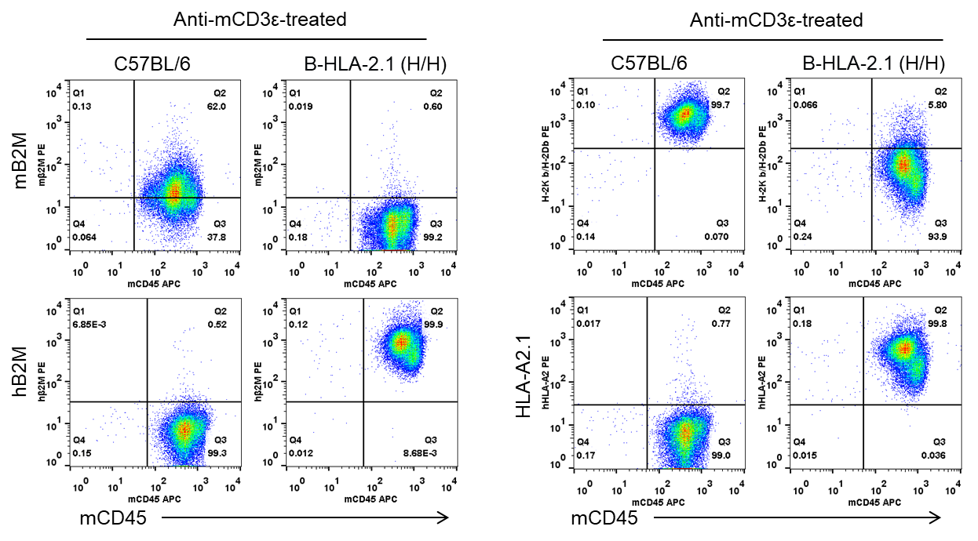
- Mouse B2M and H-2Kb/H-2Db were detected exclusively in wild-type C57BL/6N mice, but not in homozygous B-HLA-A2.1 mice.
- Human B2M and HLA-A2.1 were exclusively detected in homozygous B-HLA-A2.1 mice.
Strain specific B2M and HLA expression analysis in homozygous B-HLA-A2.1 mice by flow cytometry. Splenocytes from both wild-type C57BL/6N (+/+) and homozygous B-HLA-A2.1 mice (H/H) were analyzed stimulated with anti-CD3ε in vivo by flow cytometry. B2M expression was analyzed by flow cytometry using species-specific anti-mouse B2M antibody (Biolegend, 154503) and anti-human B2M (Biolegend, 316305). HLA expression was analyzed by flow cytometry using species-specific anti-H-2Kb/H-2Db antibody (Biolegend, 114607) and anti-HLA-A2 antibody (Biolegend, 343305).
Analysis of Leukocyte Subpopulations
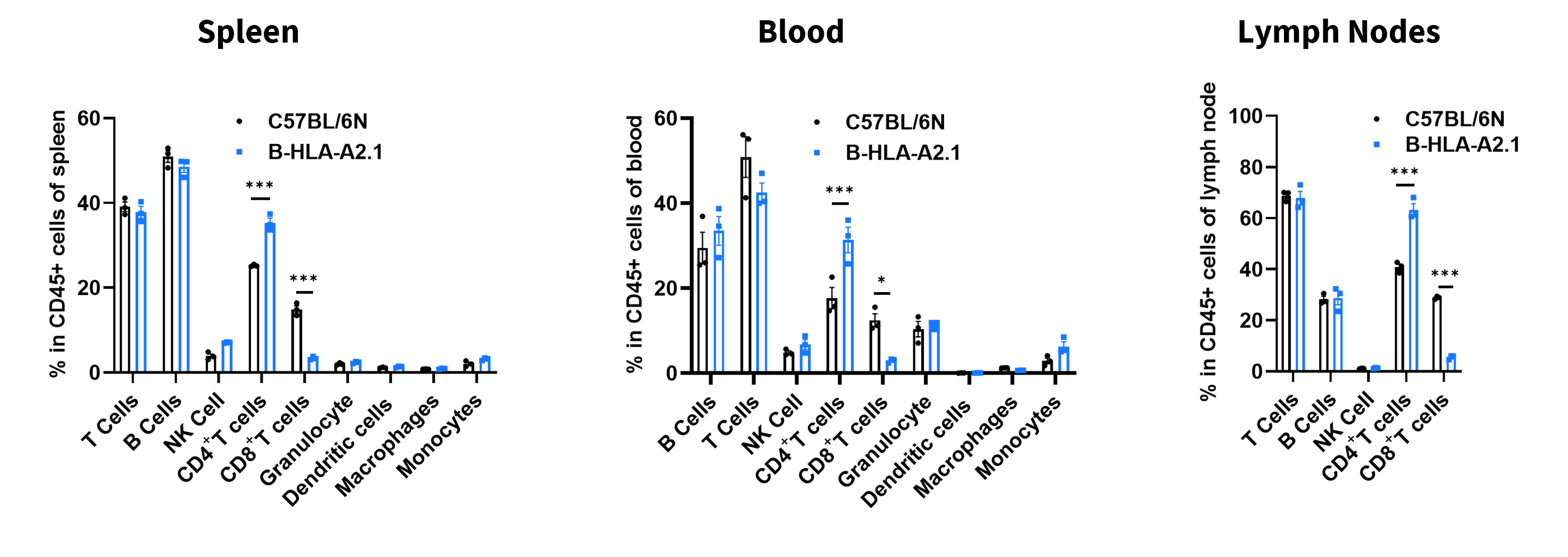
- The percentages of B cells, NK cells, DCs, neutrophils, monocytes, granulocytes, and macrophages in homozygous B-HLA-A2.1 mice were similar to those in C57BL/6N mice. The frequency of CD8+ T cells were significantly decreased while frequency of CD4+ T cells were significantly increased, demonstrating that introduction of hB2M-HLA-A2.1-H-2D in place of mouse B2M affected the development of CD8 + T cells, which in turn affected the proportion of T cell subtypes in the spleen, blood, and lymph nodes.
Analysis of leukocyte subpopulations by flow cytometry in immune organs and blood. Splenocytes, peripheral blood, and lymph nodes were isolated from female C57BL/6N and B-HLA-A2.1 mice (female, 8-week-old, n = 3). Single live cells were gated on the CD45⁺ population and analyzed by flow cytometry as indicated. Values are expressed as mean ± SEM.
Analysis of T Cell Subpopulations
- The proportion of Tregs in homozygous B-HLA-A2.1 mice were comparable to those in C57BL/6N mice. The frequency of CD8+ T cells were significantly decreased while the frequency of CD4+ T cells were significantly increased, demonstrating that introduction of hB2M-HLA-A2.1-H-2D in place of mouse B2M affected the development of CD8 + T cells, which in turn affected the proportion of T cell subtypes in the spleen, blood, and lymph nodes.
Analysis of T-cell subpopulations by flow cytometry in immune organs and blood. Splenocytes, peripheral blood, and lymph nodes were isolated from female C57BL/6N and B-HLA-A2.1 mice (female, 8-week-old, n = 3). Single live cells were gated on the CD3⁺ T-cell population and analyzed by flow cytometry as indicated. Values are expressed as mean ± SEM.
Growth Curve
Growth curve of wild-type C57BL/6JNifdc and B-HLA-A2.1 mice. Eight-week-old mice were grouped by sex (10 males and 10 females). Body weight was measured on the same day of every two week, until 32 weeks. The minimum and maximum body weights shown in the table were calculated from the mean ± SD. The growth curve of the B-HLA-A2.1 mice was similar to the growth curve of C57BL/6JNifdc.
Hematology Analysis
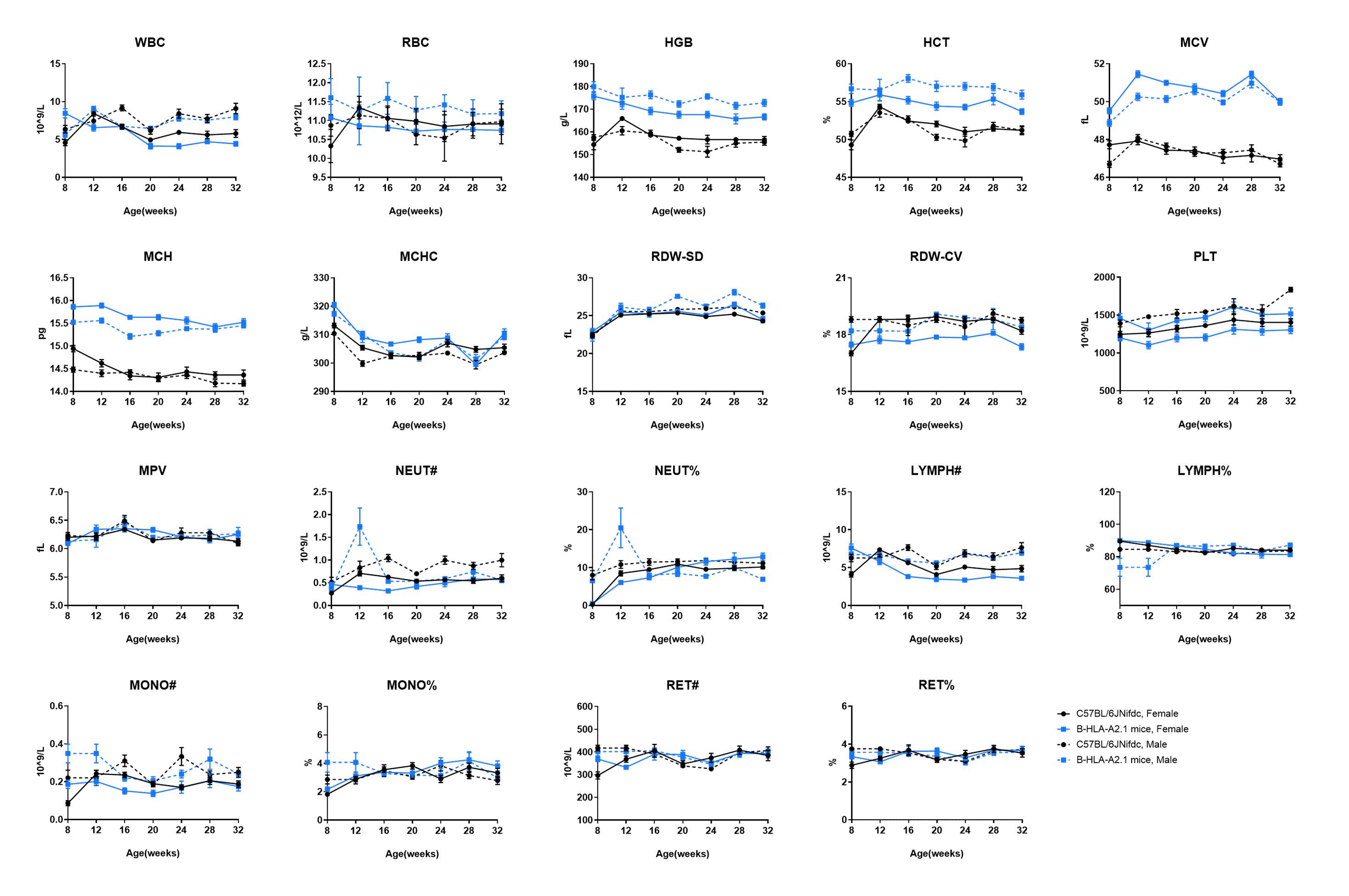
Complete blood count (CBC) of B-HLA-A2.1 mice. Values are expressed as mean ± SD.
Blood Biochemical Analysis
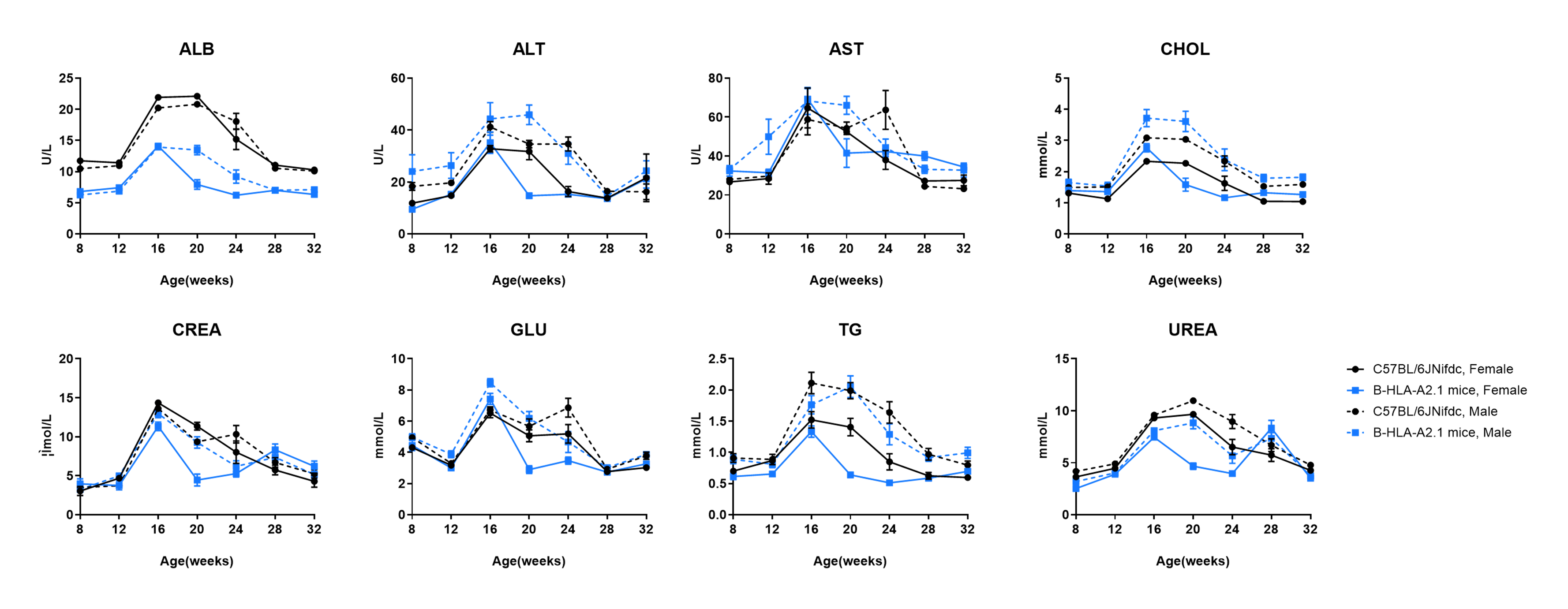
- No significant differences were observed compared with wild-type mice.
Blood biochemical parameters of B-HLA-A2.1 mice are shown. Values are expressed as mean ± SD.
Gross Organ Anatomy (Female)
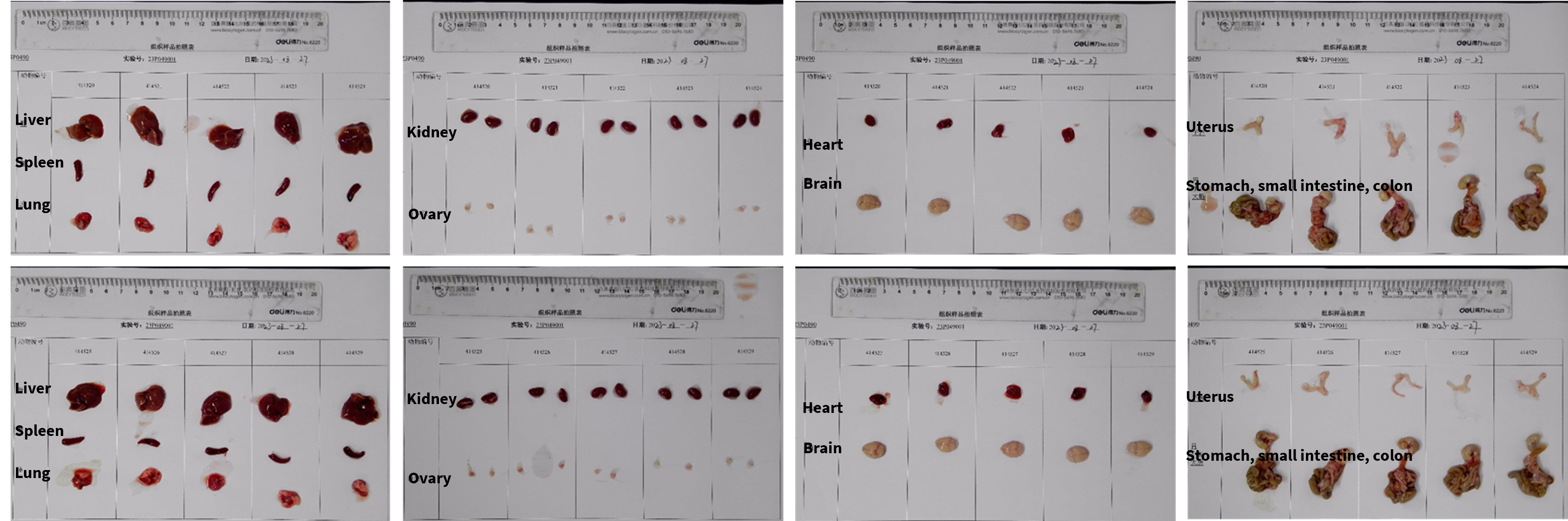
- No abnormalities were observed.
Organs of female B-HLA-A2.1 mice (8-week-old, n = 10).
Gross Organ Anatomy (Male)
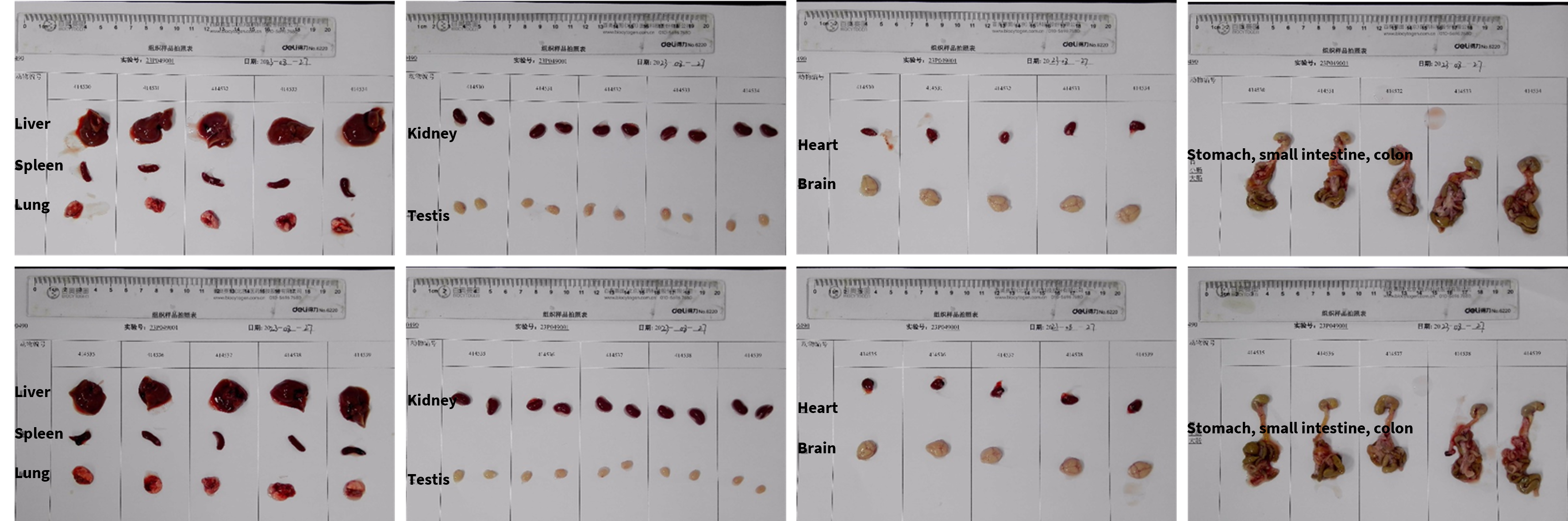
- No abnormalities were observed.
Organs of male B-HLA-A2.1 mice (8-week-old, n = 10).
Organ Weight
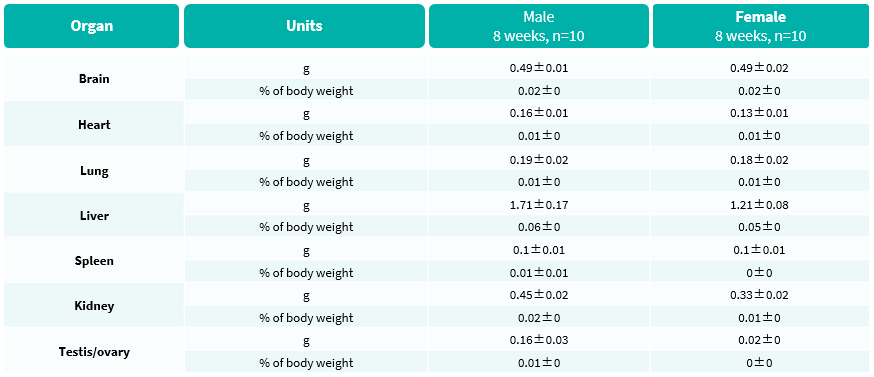
- No abnormalities were observed.
Average weights of major organs in B-HLA-A2.1 mice.
Histopathological Analysis
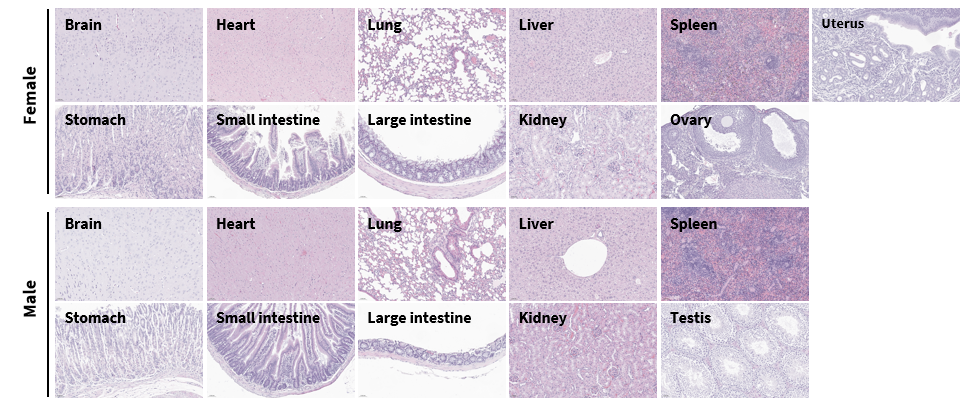
- No obvious abnormalities were observed in any organs examined (brain, heart, lung, liver, spleen, stomach, small intestine, colon, kidney, ovary, uterus ,testis, lymph node, thymus and bone marrow).
Histopathological analysis of organs in B-HLA-A2.1 mice. Major organs from B-HLA-A2.1 mice were collected at 32 weeks of age and analyzed by H&E staining (male, n = 10; female, n = 10).
Functional Validation
- HER2-targeted peptide vaccines induced immune responses in B-HLA-A2.1 mice.
- The results demonstrate that B-HLA-2.1 mice provide a powerful preclinical model for in vivo evaluation of peptide vaccines.
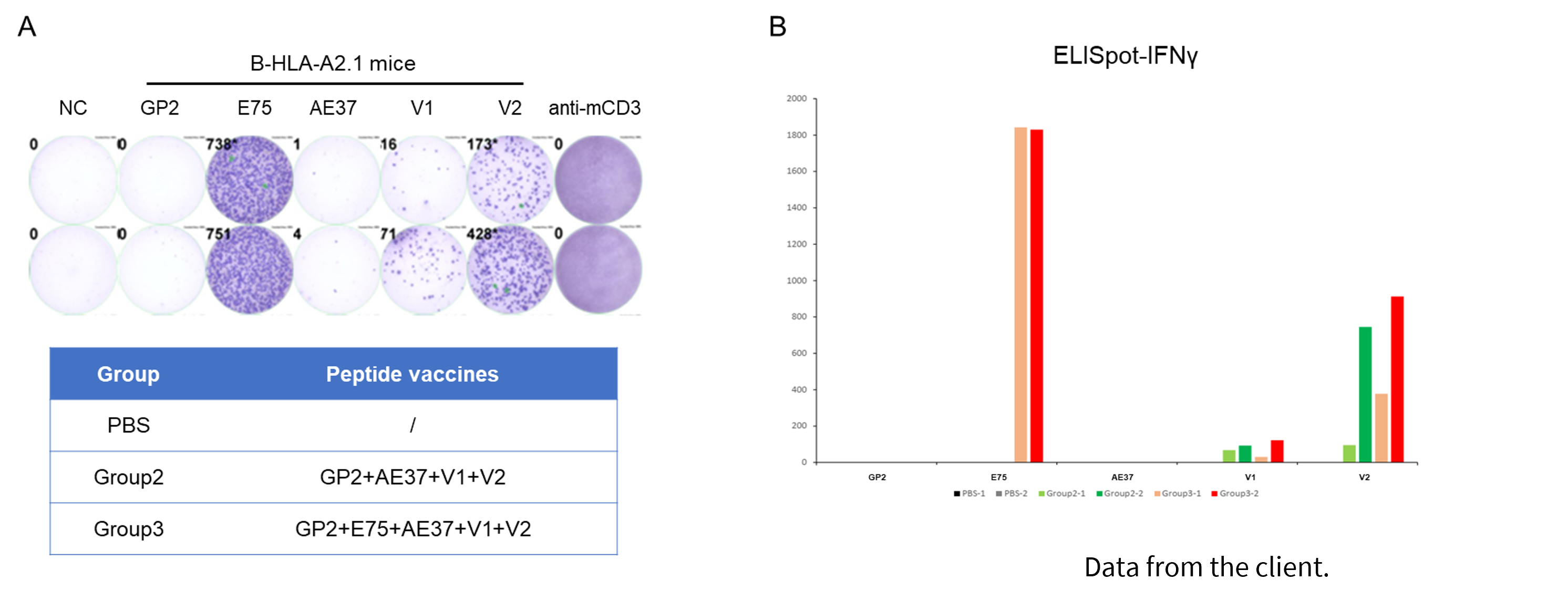
Detection of vaccine-induced immune responses in B-HLA-A2.1 mice by IFN-γ ELISpot assay. Female B-HLA-A2.1 mice at the age of 9–10 weeks were divided into PBS group, Group 2 and Group 3 (n = 2), and then inoculated PBS or vaccines at the inside muscle of both legs. Three weeks after the last immunization, mice were sacrificed. The splenocytes were extracted, stimulated with individual peptide or target-unrelated polypeptide as negative control (NC) or anti-CD3 as positive control, and then measured for IFN-γ secretion. No significant difference in body weight among groups (Data was not shown). (A) Representative results showing stimulation of splenocytes harvested from immunized mice with negative control, or peptide vaccines, or positive control in duplicates. (B) ELISpot Quantification: Statistical summary of IFN-γ-secreting cells.
- NY-ESO-1-targeted peptide vaccines induced immune responses in B-HLA-A2.1 mice.
- The results demonstrate that B-HLA-2.1 mice provide a powerful preclinical model for in vivo evaluation of peptide vaccines.
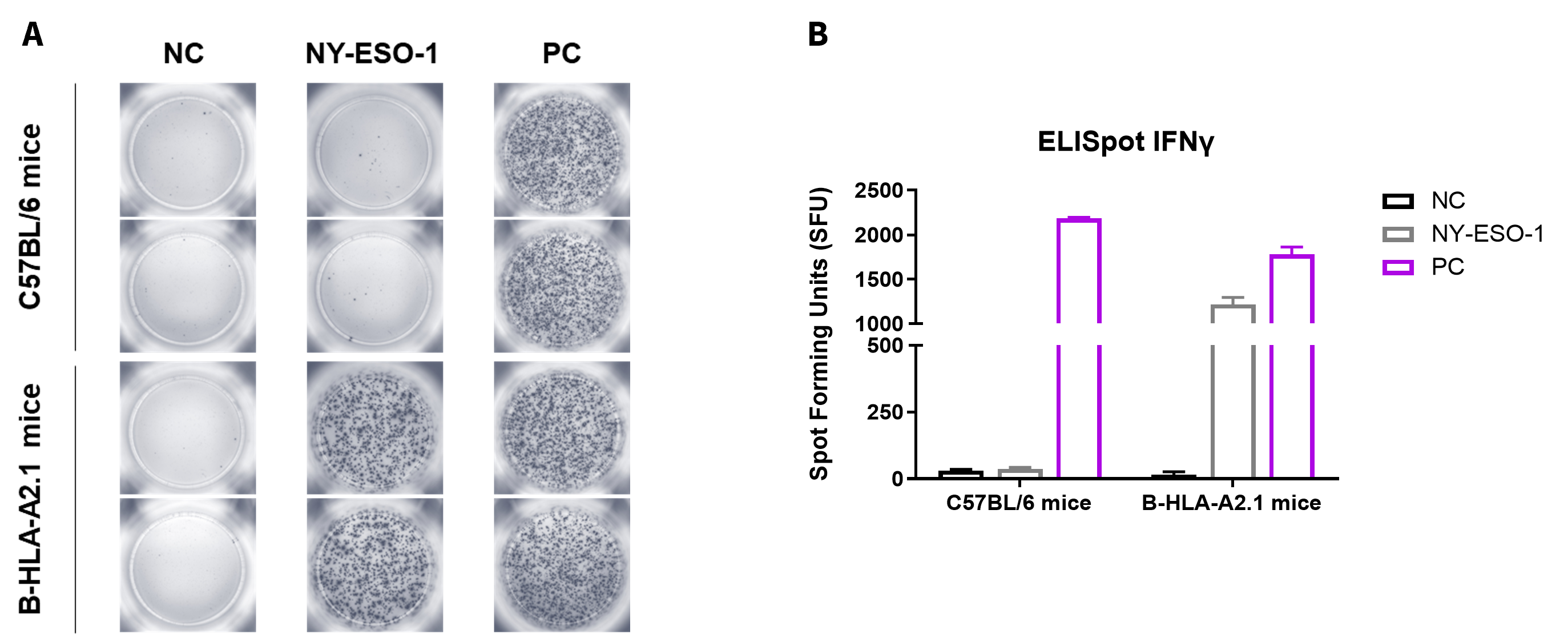
Detection of vaccine-induced immune responses in B-HLA-A2.1 mice by IFN-γ ELISpot assay. Male B-HLA-A2.1 mice at the age of 9–10 weeks were divided into PBS group and NY-ESO-1 group (n = 3), and then inoculated PBS or vaccines at the inside muscle of both legs. One week after the last immunization, mice were sacrificed. The splenocytes were extracted, stimulated with individual peptide or target-unrelated polypeptide as negative control (NC) or PMA/Ionomycin as positive control, and then measured for IFN-γ secretion. No significant difference in body weight among groups (Data was not shown). (A) Representative results showing stimulation of splenocytes harvested from immunized mice with negative control, or peptide vaccines, or positive control in duplicates. (B) ELISpot Quantification: Statistical summary of IFN-γ-secreting cells.
Anti-tumor Effect of WT1-Db126 against B-HLA-A2.1/hWT1 MC38 Tumor Cells
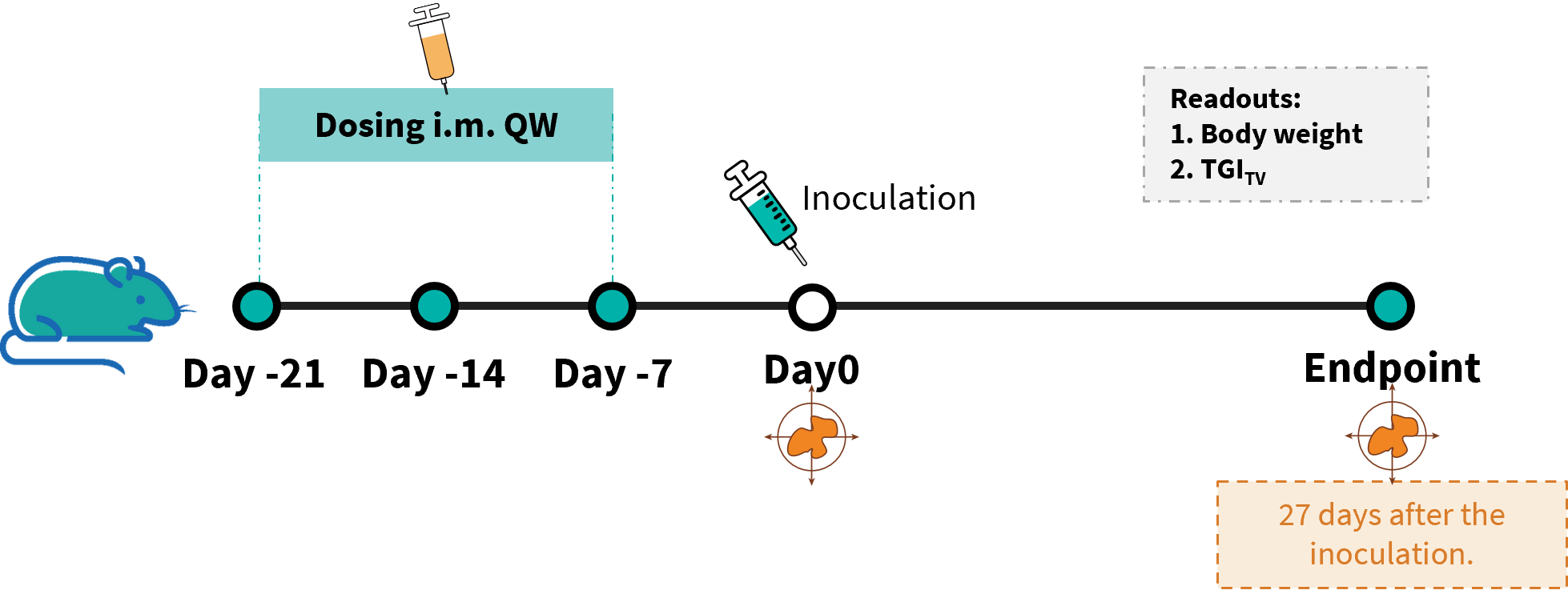
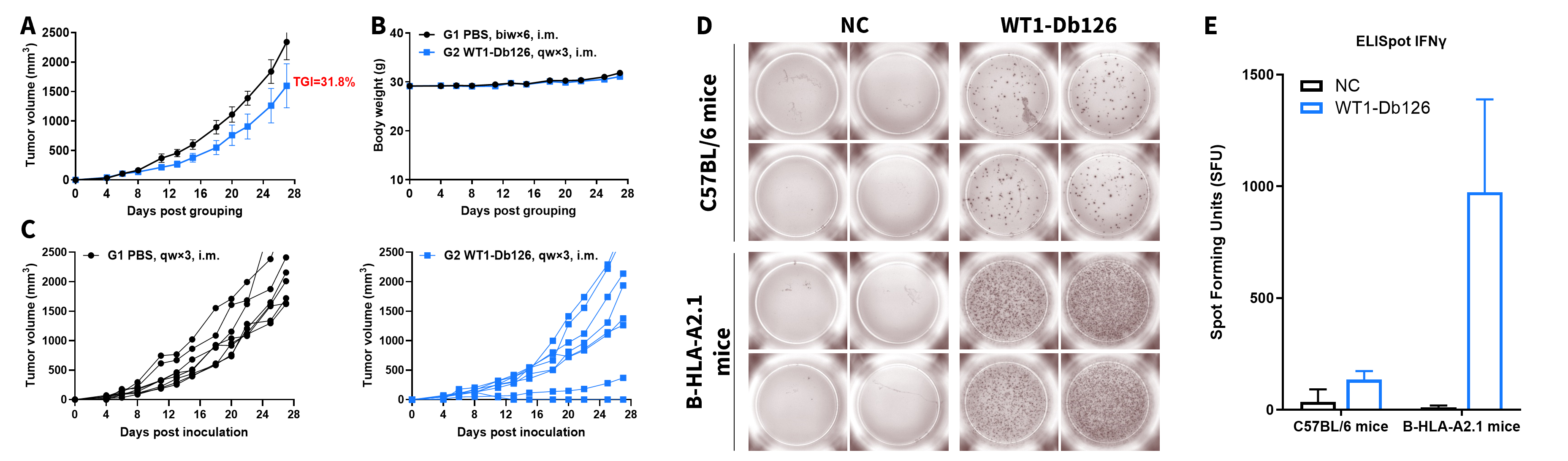
Establishment of a B-HLA-A2.1/hWT1 MC38 model and in vivo efficacy study of an anti-human WT1 peptide. B-HLA-A2.1/hWT1 MC38 cells were implanted subcutaneously into homozygous B-HLA-A2.1 mice (male, 8-weeks-old, n=8).
Antitumor activity of WT1-Db126 against syngeneic tumors. (A) Tumor growth curves. (B) Body weight changes during treatment. (C) Tumor cells growth of individual mouse. (D) Representative results showing stimulation of splenocytes harvested from immunized mice with negative control, or peptide vaccines in duplicates. (E) ELISpot Quantification: Statistical summary of IFN-γ-secreting cells. These results demonstrate that B-HLA-A2.1 mice provide a powerful preclinical model for in vivo evaluation of vaccines. The overage of this tumor model is 40%.
The Intracellular Cytokine Staining (ICS) Assay
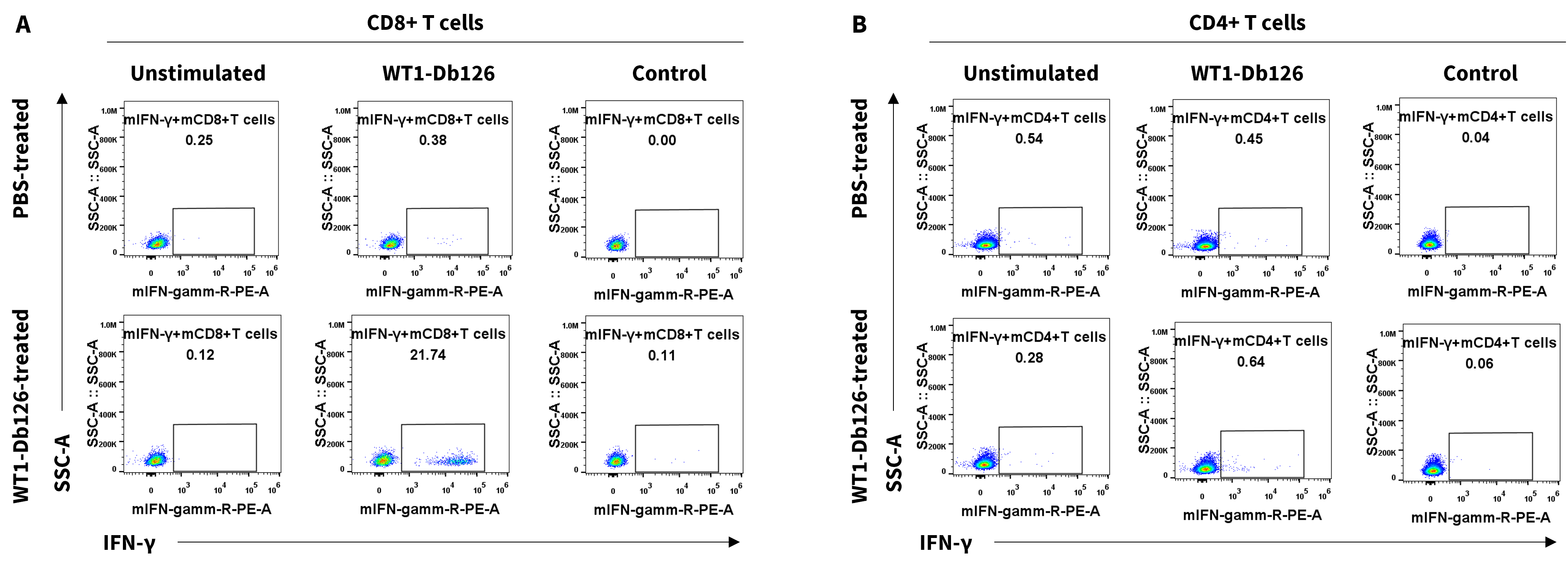
- The intracellular cytokine staining (ICS) results demonstrated that the IFN-γ was produced by the CD8+ T cells but not the CD4+ T cells.
T-cell intracellular cytokine staining (ICS) assays. FACS plots demonstrating WT1-Db126-specific CD4+ and CD8+ T cells for B-HLA-A2.1 mice. CD8+ T cells produced primarily IFN-γ (A), whereas CD4+ cells didn’t produce IFN-γ (B).
Anti-tumor Effect of NY-ESO-1 Peptides against B-HLA-A2.1/hNY-ESO-1 MC38 Tumor Cells
Establishment of a B-HLA-A2.1/hNY-ESO-1 MC38 model and in vivo efficacy study of an anti-human NY-ESO-1 peptides. B-HLA-A2.1/hNY-ESO-1 MC38 cells were implanted subcutaneously into homozygous B-HLA-A2.1 mice (male, 8-weeks-old, n=6 or 8).
Antitumor activity of NY-ESO-1 peptides against syngeneic tumors. (A) Tumor growth curves. (B) Body weight changes during treatment. (C) Tumor cells growth of individual mouse. These results demonstrate that B-HLA-A2.1 mice provide a powerful preclinical model for in vivo evaluation of peptide vaccines.
The overage of this tumor model is 40%.
Functional Validation
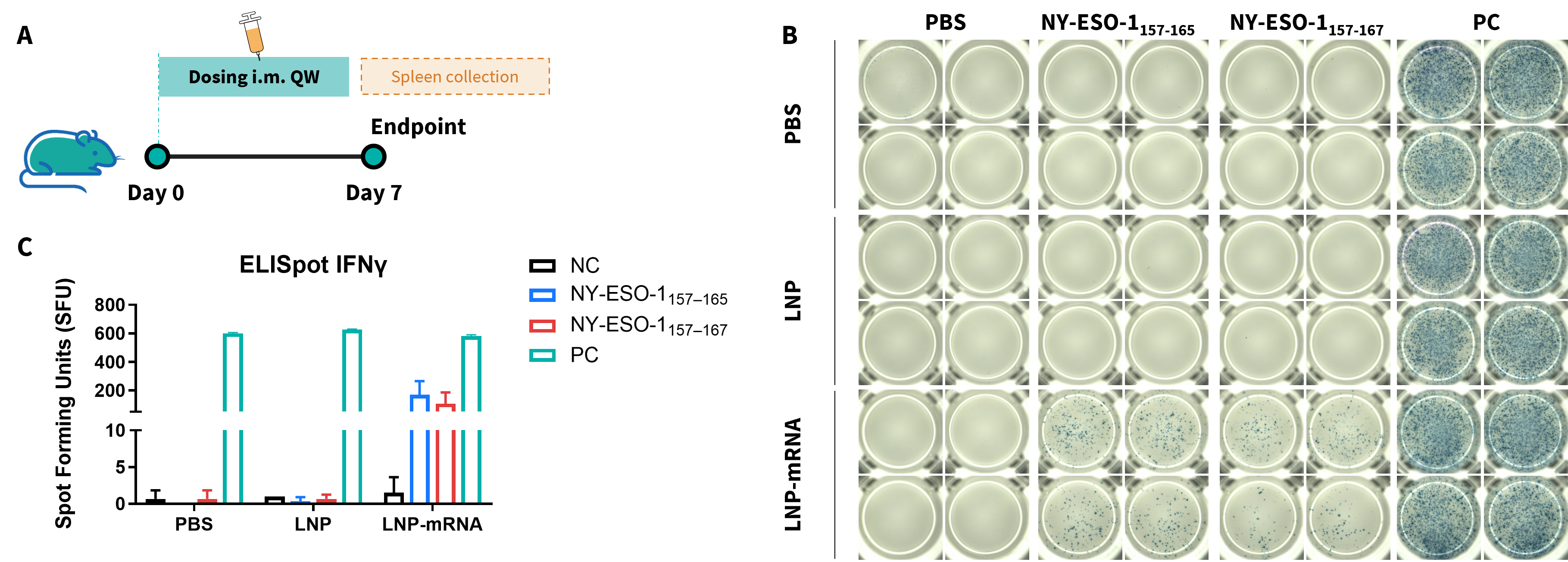
- One dose of NY-ESO-1-targeted LNP mRNA vaccines induced immune responses in B-HLA-A2.1 mice.
- The results demonstrate that B-HLA-2.1 mice provide a powerful preclinical model for in vivo evaluation of LNP mRNA vaccines.
Detection of vaccine-induced immune responses in B-HLA-A2.1 mice by IFN-γ ELISpot assay. (A) Scheme of vaccination and testing. Male B-HLA-A2.1 mice (9-10-week-old, n=3) were immunized via intramuscular injection in both hind legs with PBS, empty LNPs, or LNP-mRNA. One week post-immunization, splenocytes were harvested and stimulated with specific peptides, no peptide (NC), or PMA/Ionomycin (PC) to measure IFN-γ secretion. No significant difference in body weight among groups (Data was not shown). (B) ELISpot Results: Representative assay wells. (C) ELISpot Quantification: Statistical summary of IFN-γ-secreting cells. NC: negative control. PC: positive control.
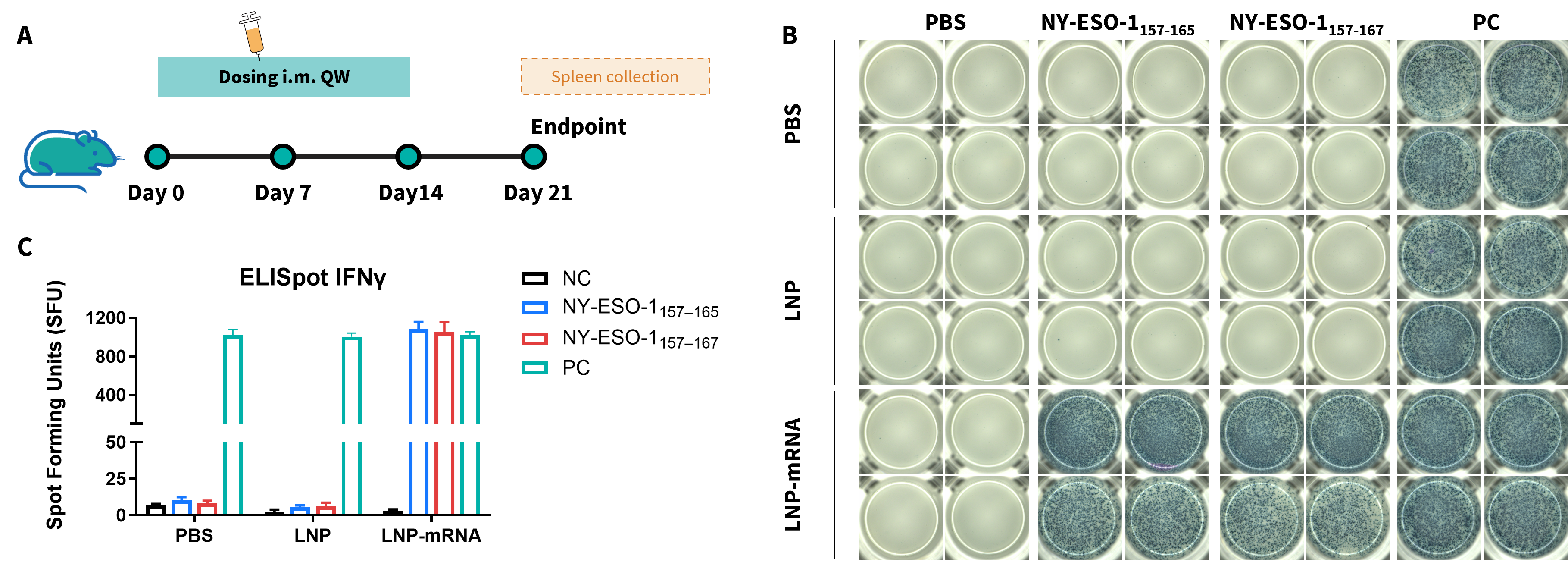
- Three doses of NY-ESO-1-targeted LNP mRNA vaccines induced strong immune responses in B-HLA-A2.1 mice.
- The results demonstrate that B-HLA-2.1 mice provide a powerful preclinical model for in vivo evaluation of LNP mRNA vaccines.
Detection of vaccine-induced immune responses in B-HLA-A2.1 mice by IFN-γ ELISpot assay. (A) Scheme of vaccination and testing. Male B-HLA-A2.1 mice (9-10-week-old, n=3) were immunized via intramuscular injection in both hind legs with PBS, empty LNPs, or LNP-mRNA. One week post-immunization, splenocytes were harvested and stimulated with specific peptides, no peptide (NC), or PMA/Ionomycin (PC) to measure IFN-γ secretion. No significant difference in body weight among groups (Data was not shown). (B) ELISpot Results: Representative assay wells. (C) ELISpot Quantification: Statistical summary of IFN-γ-secreting cells. NC: negative control. PC: positive control.
Anti-tumor Effect of LNP-mRNA against B-HLA-A2.1/hNY-ESO-1 MC38 Tumor Cells
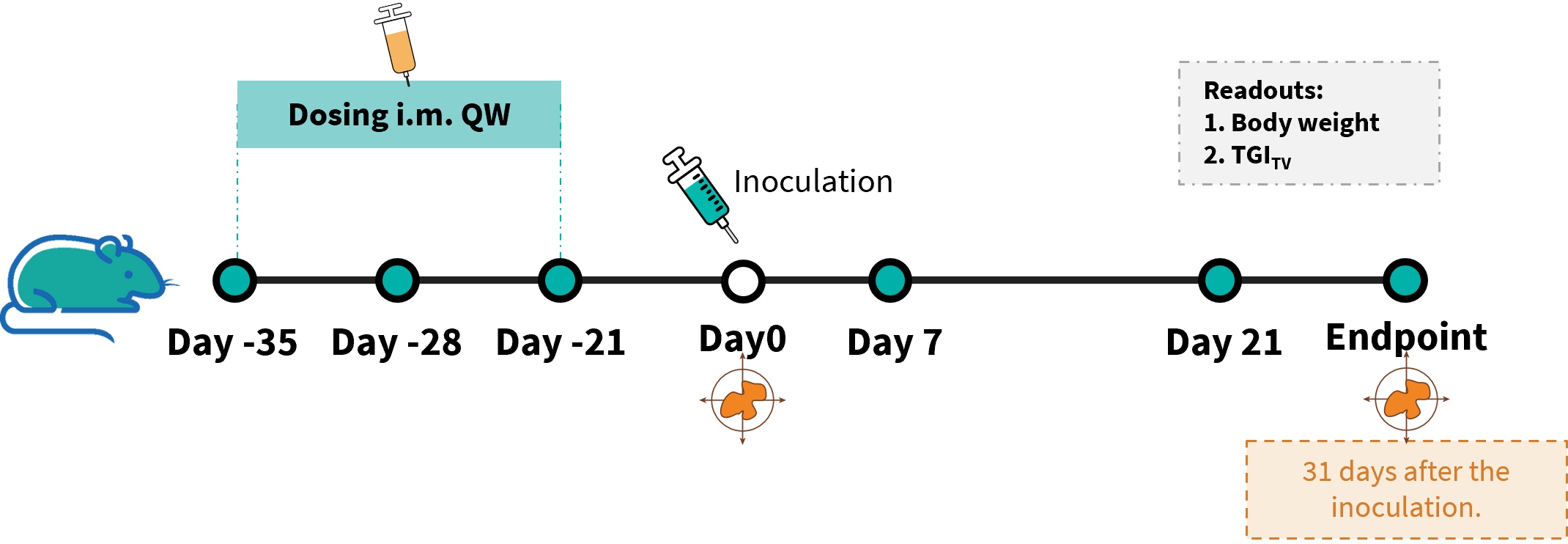
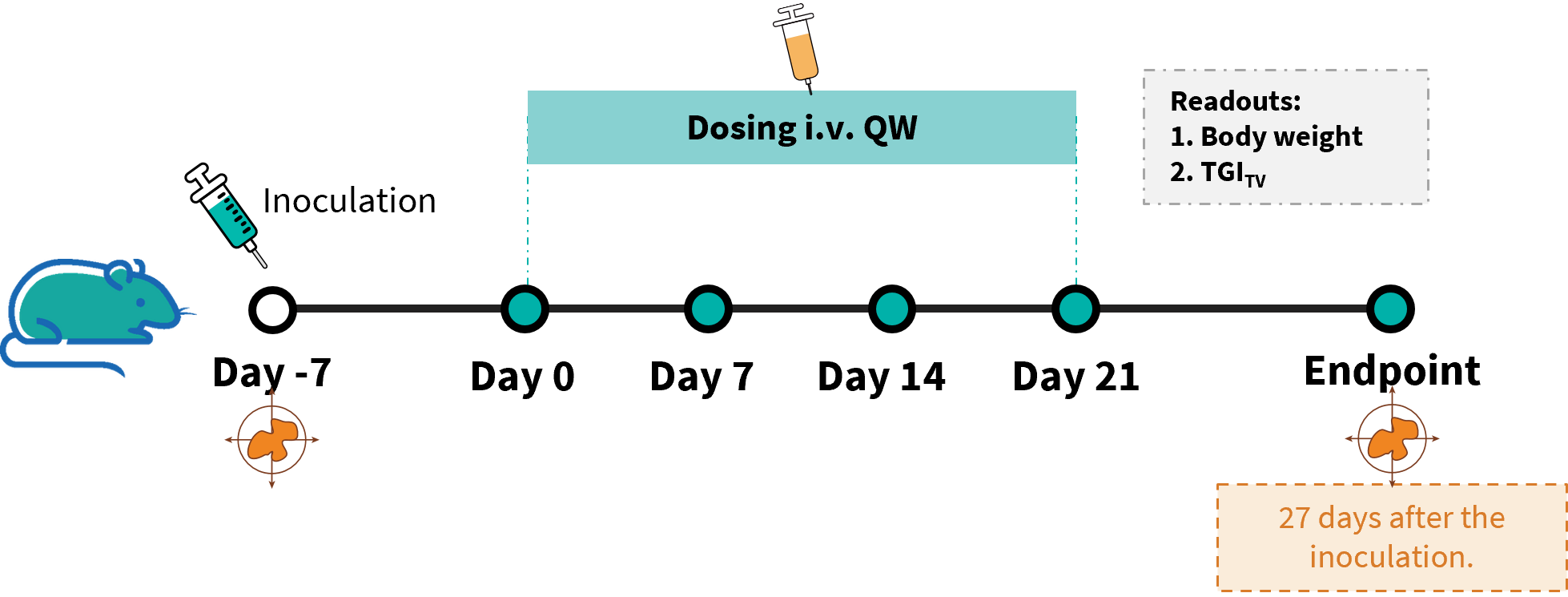
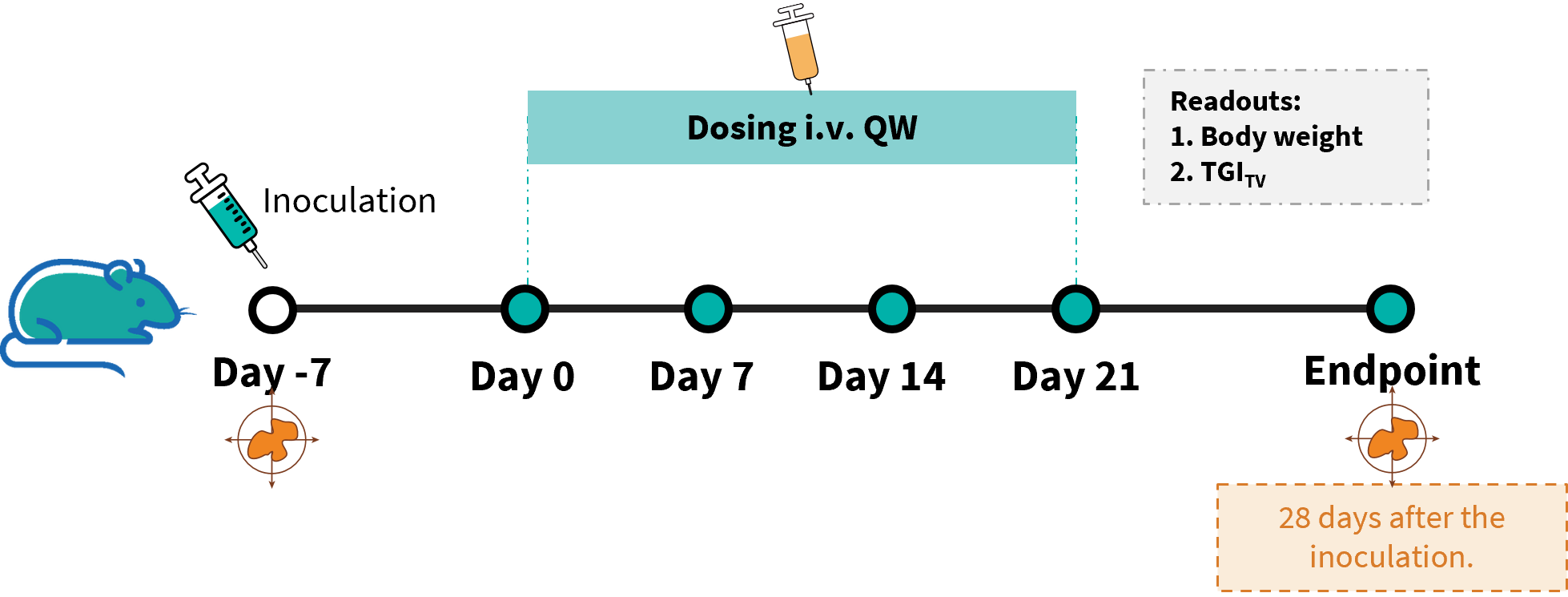
Establishment of a B-HLA-A2.1/hNY-ESO-1 MC38 model and in vivo efficacy study of an anti-human NY-ESO-1 LNP mRNA. B-HLA-A2.1/hNY-ESO-1 MC38 cells were implanted subcutaneously into homozygous B-HLA-A2.1 mice (male, 9-weeks-old, n=6).
Antitumor activity of NY-ESO-1 mRNA vaccine against syngeneic tumors. (A) Tumor growth curves. (B) Body weight changes during treatment. (C) Tumor cells growth of individual mouse. These results demonstrate that B-HLA-A2.1 mice provide a powerful preclinical model for in vivo evaluation of LNP-mRNA vaccines.
The overage of this tumor model is 40%.
The Cytotoxicity Assay of CTLs to the B-HLA-A2.1/hNY-ESO-1 MC38
- Under two different effector-to-target ratios, compared with the PBS group and the empty LNP group, cells from the vaccine group after immunization showed significant killing effects.
LDH release assay for cytotoxicity of CTLs from B-HLA-A2.1 mice immunized with PBS, LNP or LNP-mRNA against the B-HLA-A2.1/hNY-ESO-1 MC38 cell line. Cytotoxic activities of isolated single splenocytes of immunized mice against NY-ESO-1 peptides pulsed B-HLA-A2.1/hNY-ESO-1 MC38 cell line were detected by LDH release assay at effector-to-target ratio of 50:1 or 100:1 with two different peptide concentrations, 10 μg/ml or 50 μg/ml.
Vaccination LNP-mRNA Generates Specific Effector CD8+ T Cells in Spleens
- LNP-mRNA enhances infiltration of effector T and reduces Treg cells in the spleens.
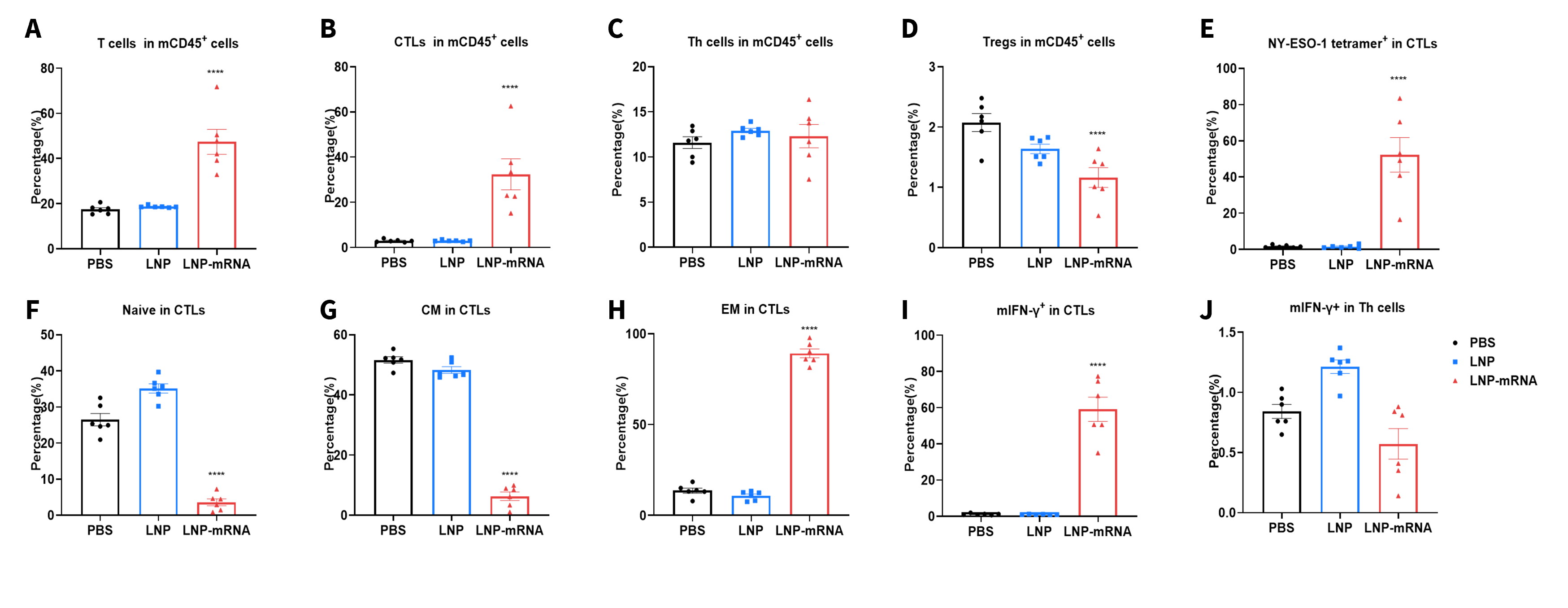
Vaccination LNP-mRNA generates specific effector CD8+ T cells in spleens. Spleens from B-HLA-A2.1/hNY-ESO-1 MC38 tumor-bearing mice that were immunized with the PBS, empty LNP or LNP-mRNA were analyzed on day 27. Analysis of CD8+T, CD4+ T and Treg cells in the spleens determined by the flow cytometric assay. For spleen T(A) and CD8+T cells(B), the percentage(in CD45+ cells) were significantly elevated. LNP-mRNA generated frequencies of tetramer+ CD8+ T cells at approximately 50% of total CD8+ T cells in spleens(E). The CD8+ T cells had an obviously lower frequency in the naïve(F) and central memory(G) and were mainly localized in the effector memory(H). The IFNγ were mainly secreted by CD8+ (I) but not CD4+T(J).
Vaccination LNP-mRNA Generates Specific Effector CD8+ T Cells in TME
- LNP-mRNA enhances infiltration of effector T and reduces Treg cells in the TME.
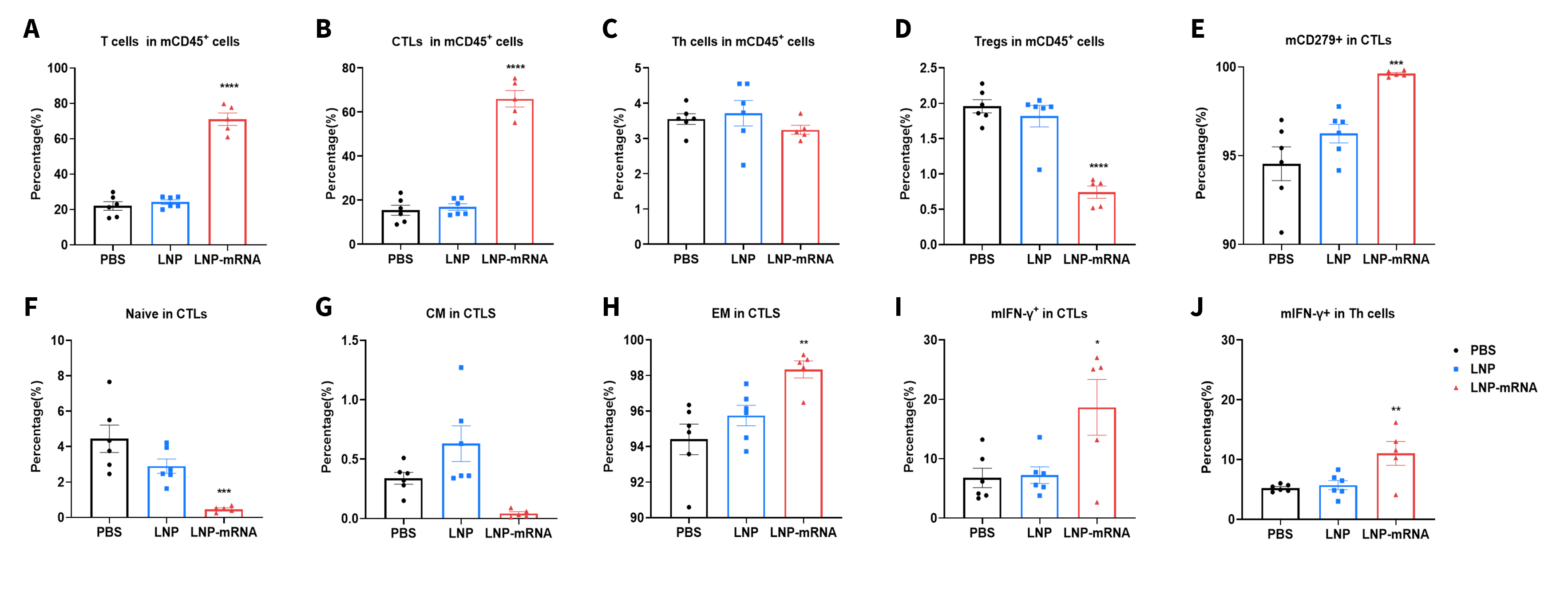
LNP-mRNA enhances beneficial repertoire of anti-tumor T cells. Tumors from B-HLA-A2.1/hNY-ESO-1 MC38 tumor-bearing mice that were immunized with the PBS, empty LNP or LNP-mRNA were analyzed on day 27. Analysis of CD8+T, CD4+ T and Treg cells in the tumors determined by the flow cytometric assay. For tumor-infiltrated T (A) and CD8+T cells (B), the percentage (in CD45+ cells) were significantly elevated. In contrast, the frequencies of Tregs was significantly diminished in LNP-mRNA group (D). Tumor-infiltrated CD8+ T cells had an obviously lower frequency in the naïve (F) and the effector memory(EM) CD8+T cells was increased significantly (H). The IFNγ in Both CD8+ T cells (I) and CD4+T cells (J) produced IFNγ.
Anti-tumor Effect of LNP-mRNA against B-HLA-A2.1/hWT1 MC38 Tumor Cells
Establishment of a B-HLA-A2.1/hWT1 MC38 model and in vivo efficacy study of an anti-human WT1 LNP mRNA. B-HLA-A2.1/hWT1 MC38 cells were implanted subcutaneously into homozygous B-HLA-A2.1 mice (female, 9-weeks-old, n=8).
Anti-tumor Effect of LNP mRNA against B-HLA-A2.1/hWT1 MC38 Tumor Cells
Antitumor activity of WT1 mRNA vaccine against syngeneic tumors. (A) Tumor growth curves. (B) Body weight changes during treatment. (C) Tumor cells growth of individual mouse. These results demonstrate that B-HLA-A2.1 mice provide a powerful preclinical model for in vivo evaluation of LNP-mRNA vaccines.
The overage of this tumor model is 40%.
The Cytotoxicity Assay of CTLs to the B-HLA-A2.1/hWT1 MC38
- Under two different effector-to-target ratios, compared with the PBS group and the empty LNP group, cells from the vaccine group after immunization showed significant killing effects.
LDH release assay for cytotoxicity of CTLs from B-HLA-A2.1 mice immunized with PBS, LNP or LNP-mRNA against the B-HLA-A2.1/hWT1 MC38 cell line. Cytotoxic activities of isolated single splenocytes of immunized mice against WT1 peptides pulsed B-HLA-A2.1/hWT1 MC38 cell line were detected by LDH release assay at effector-to-target ratio of 50:1 or 100:1 with 10 μg/ml peptides.
Vaccination LNP-mRNA Generates Specific Effector CD8+ T Cells in Spleens
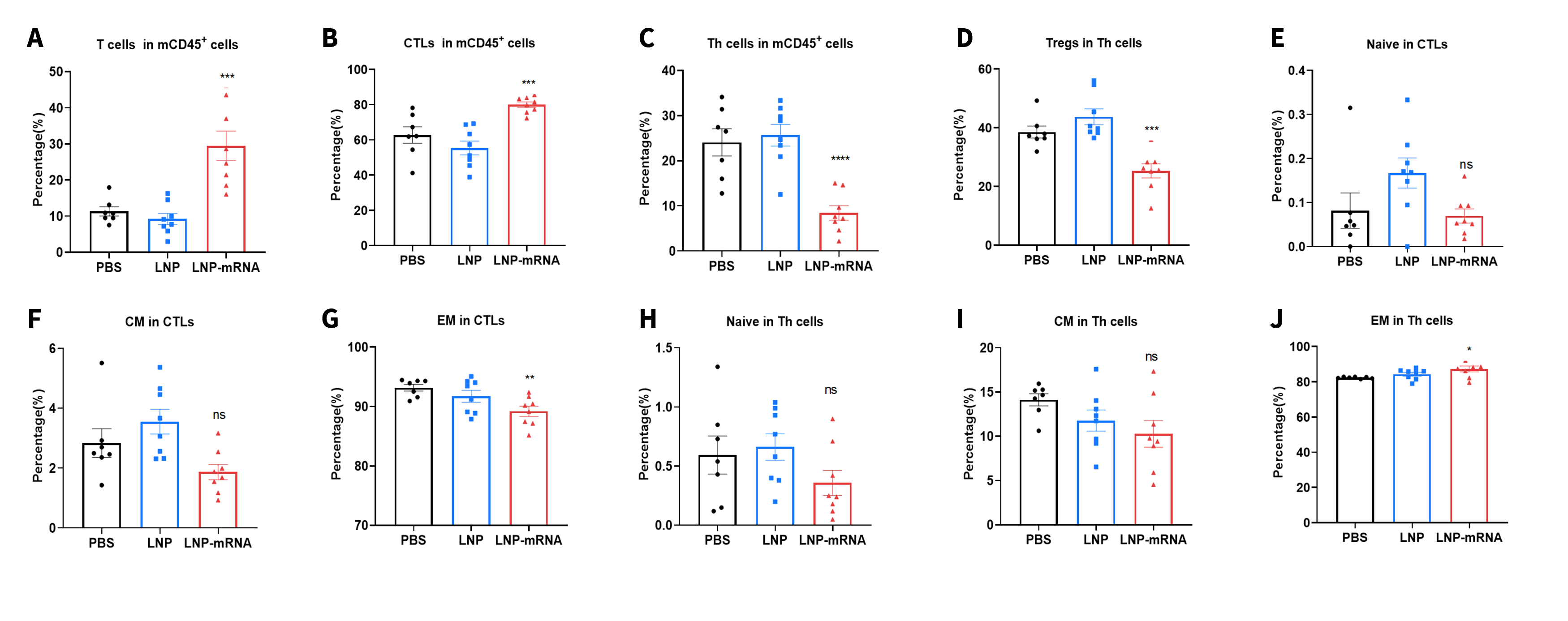
- LNP-mRNA enhances infiltration of effector T and reduces Treg cells in the spleens.
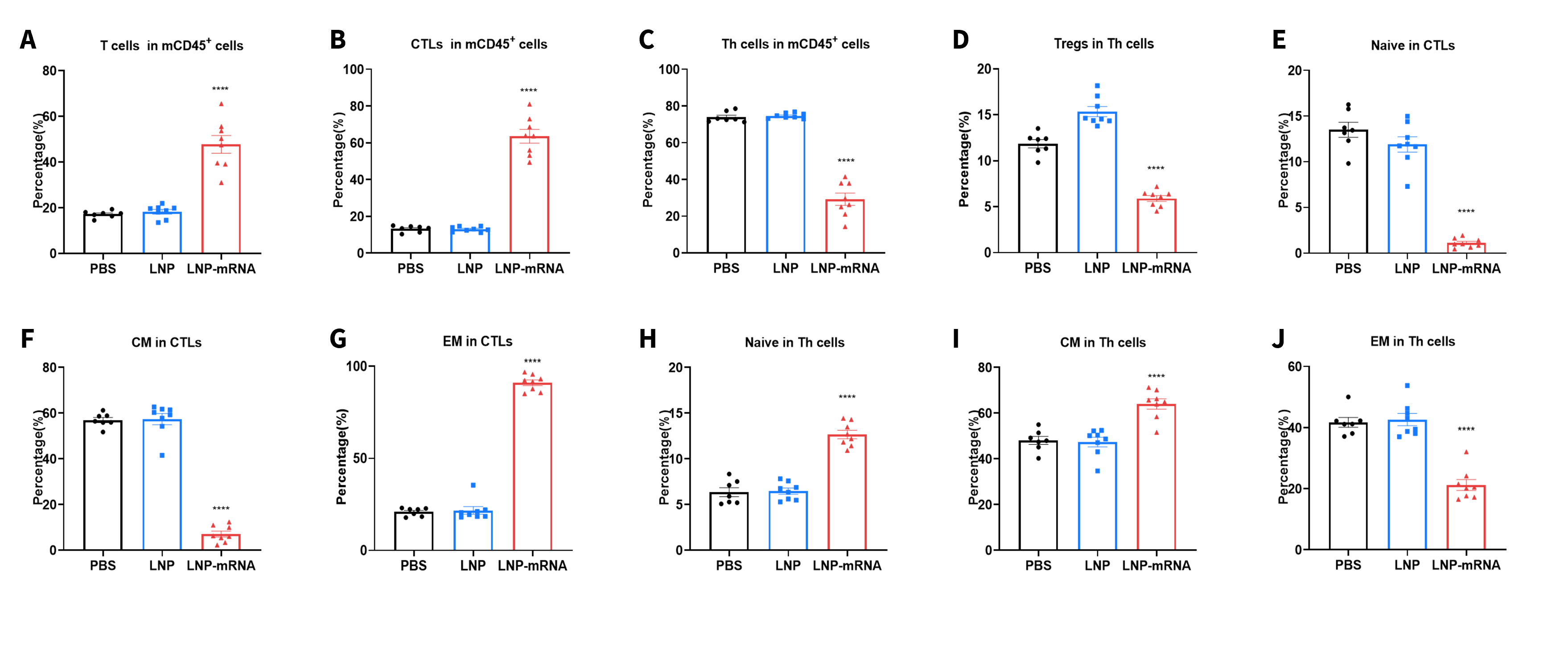
Vaccination LNP-mRNA generates specific effector CD8+ T cells in spleens. Spleens from B-HLA-A2.1/hWT1 MC38 tumor-bearing mice that were immunized with the PBS, empty LNP or LNP-mRNA were analyzed on day 28. Analysis of CD8+T, CD4+ T and Treg cells in the spleens determined by the flow cytometric assay. For spleen T cells(A), and CD8+T cells(B), the percentage(in CD45+ cells) were significantly elevated. The CD8+ T cells had an obviously lower frequency in the naïve(E) and central memory(F) and were mainly localized in the effector memory(G), while the trend of Th cells was opposite to that of CD8+T cells(H-J).
Vaccination LNP-mRNA Generates Specific Effector CD8+ T Cells in TME
- LNP-mRNA enhances infiltration of effector T and reduces Treg cells in the TME.
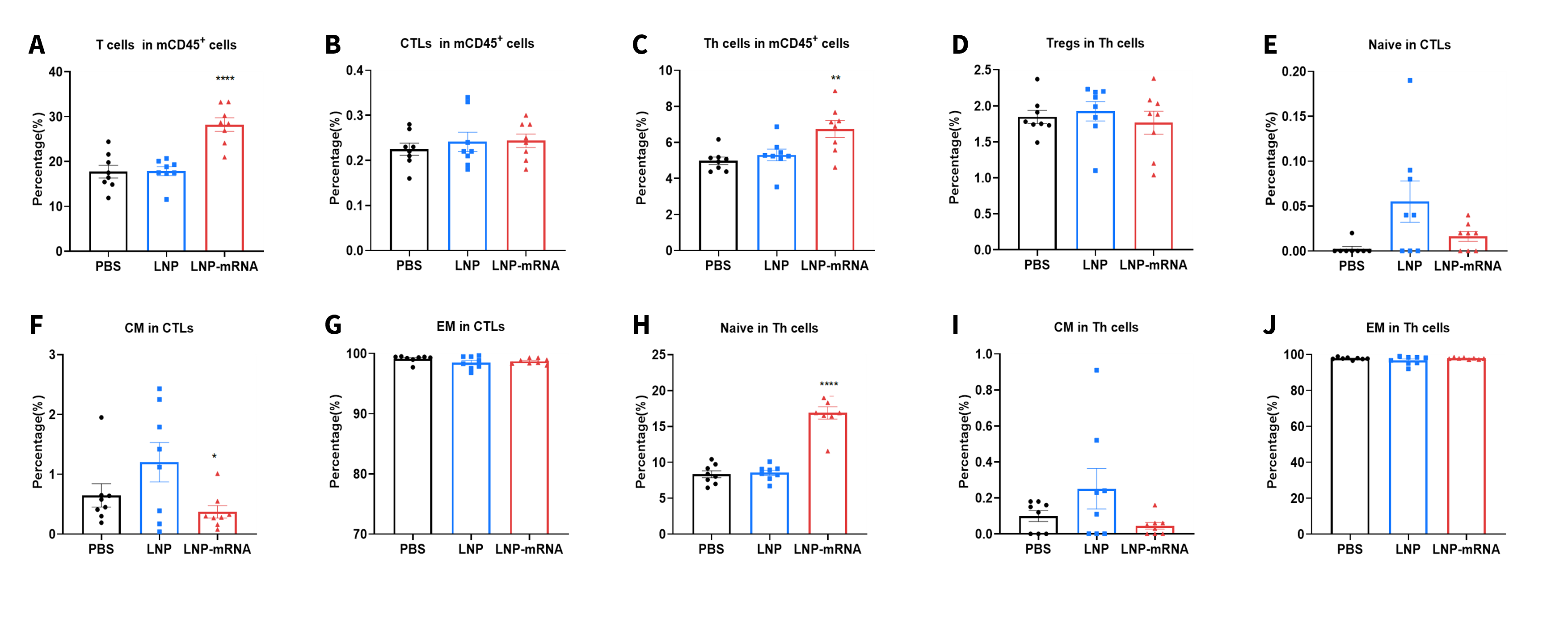
LNP-mRNA enhances beneficial repertoire of anti-tumor T cells. Tumors from B-HLA-A2.1/hWT1 MC38 tumor-bearing mice that were immunized with the PBS, empty LNP or LNP-mRNA were analyzed on day 28. Analysis of CD8+T, CD4+ T and Treg cells in the tumors determined by the flow cytometric assay. For tumor-infiltrated T(A) and CD8+T cells(B), the percentage(in CD45+ cells) were significantly elevated. In contrast, the frequencies of Tregs was significantly diminished in LNP-mRNA group(D). Tumor-infiltrated effector memory(EM) CD4+T cells was increased significantly(J).
Anti-tumor Effect of LNP-mRNA against B-HLA-A2.1/hGP100 MC38 Tumor Cells
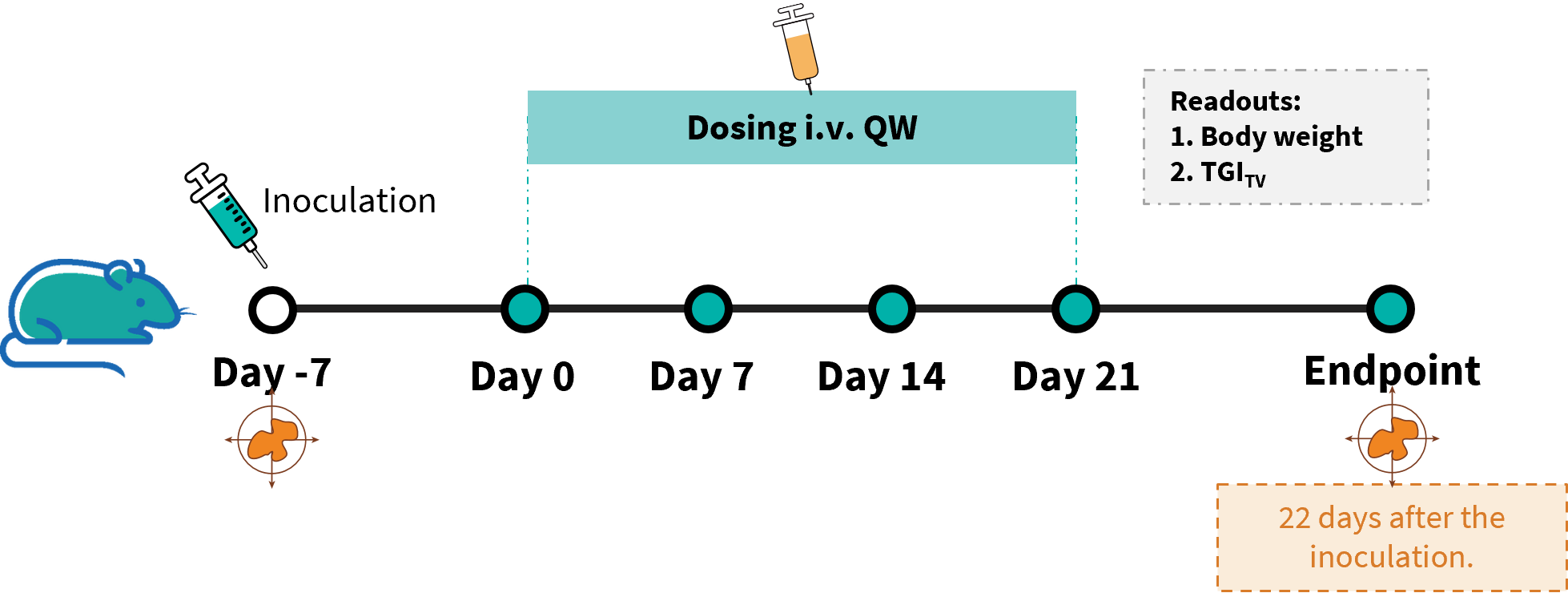
Establishment of a B-HLA-A2.1/hGP100 MC38 model and in vivo efficacy study of an anti-human GP100 LNP mRNA. B-HLA-A2.1/hGP100 MC38 cells were implanted subcutaneously into homozygous B-HLA-A2.1 mice (female, 8-weeks-old, n=8).
Antitumor activity of GP100 mRNA vaccine against syngeneic tumors. (A) Tumor growth curves. (B) Body weight changes during treatment. (C) Tumor cells growth of individual mouse. These results demonstrate that B-HLA-A2.1 mice provide a powerful preclinical model for in vivo evaluation of LNP-mRNA vaccines.
The overage of this tumor model is 40%.
The Cytotoxicity Assay of CTLs to the B-HLA-A2.1/hGP100 MC38
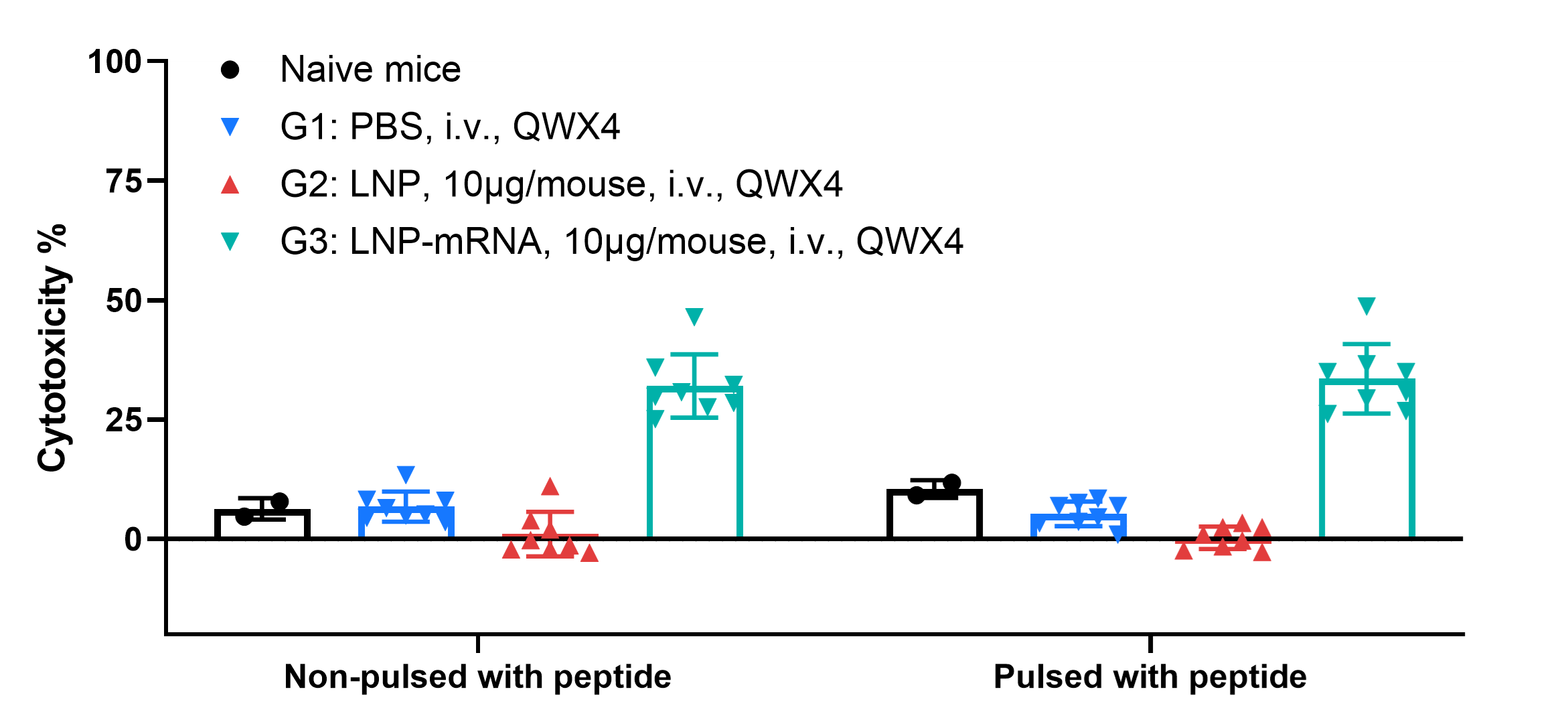
- Under two different effector-to-target ratios, compared with the PBS group and the empty LNP group, cells from the vaccine group after immunization showed significant killing effects.
LDH release assay for cytotoxicity of CTLs from B-HLA-A2.1 mice immunized with PBS, LNP or LNP-mRNA against the B-HLA-A2.1/hGP100 MC38 cell line. Cytotoxic activities of isolated single splenocytes of immunized mice with or without GP100 peptides pulsed B-HLA-A2.1/hGP100 MC38 cell line were detected by LDH release assay at effector-to-target ratio of 100:1 with 10 μg/ml peptides.
Vaccination LNP-mRNA Generates Specific Effector CD8+ T Cells in Spleens
- LNP-mRNA enhances infiltration of effector T and reduces Treg cells in the spleens.
Vaccination LNP-mRNA generates specific effector CD8+ T cells in spleens. Spleens from B-HLA-A2.1/hGP100 MC38 tumor-bearing mice that were immunized with the PBS, empty LNP or LNP-mRNA were analyzed on day 22. Analysis of CD8+ T, CD4+ T and Treg cells in the spleens determined by the flow cytometric assay. For spleen T cells(A), and CD8+ T cells(B), the percentages (in CD45+ cells) were significantly elevated. The CD8+ T cells had an obviously lower frequency in the central memory(F) and were mainly localized in the effector memory(G), while the trend of naïve Th cells was opposite to that of CD8+T cells(H).
Vaccination LNP-mRNA Generates Specific Effector CD8+ T Cells in TME
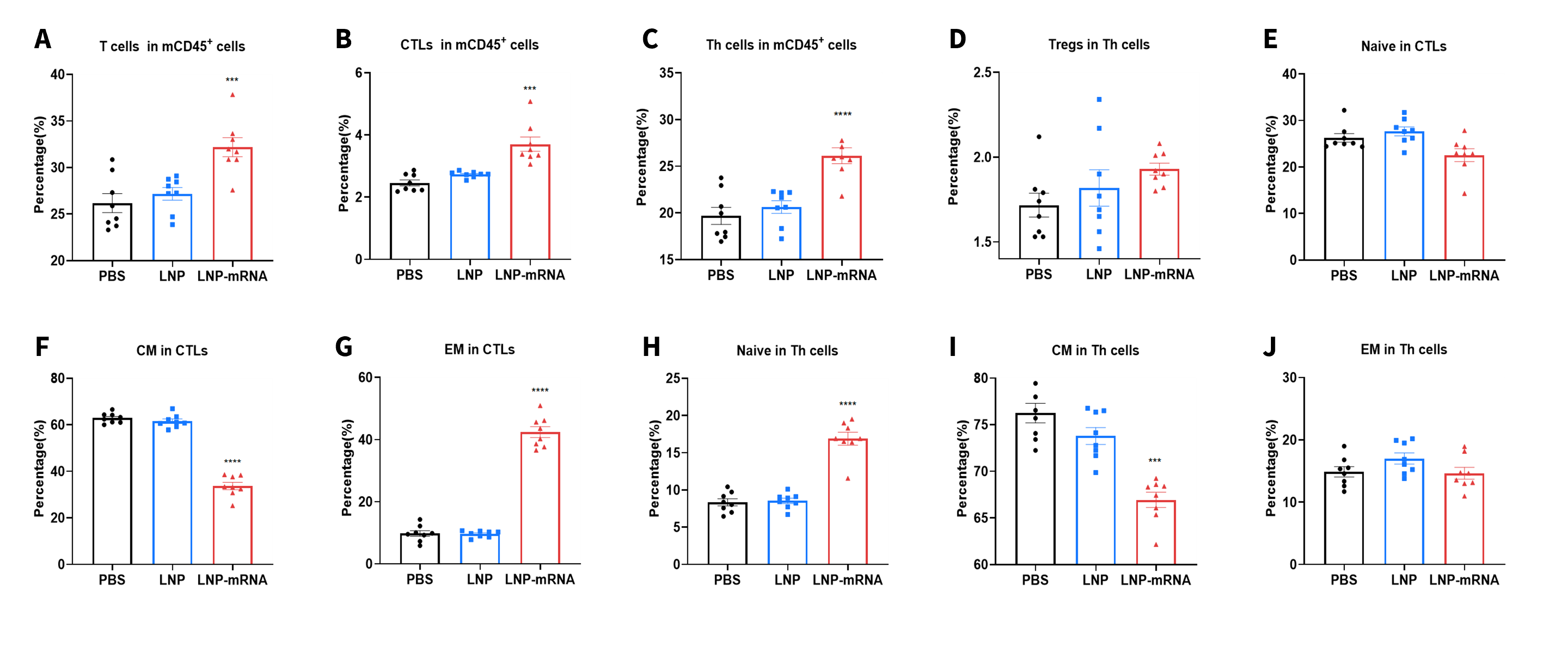
- LNP-mRNA enhances infiltration of effector T and reduces Treg cells in the TME.
LNP-mRNA enhances beneficial repertoire of anti-tumor T cells. Tumors from B-HLA-A2.1/hGP100 MC38 tumor-bearing mice that were immunized with the PBS, empty LNP or LNP-mRNA were analyzed on day 22. Analysis of CD8+ T, CD4+ T and Treg cells in the tumors determined by the flow cytometric assay. For tumor-infiltrated T(A) and CD4+ T cells(C), the percentages(in CD45+ cells) were significantly elevated. In contrast, the frequencies of CD8+ T(B) and Tregs(D) were not significantly changed in LNP-mRNA group. Tumor-infiltrated naïve CD4+T cells was increased significantly(H).
Anti-tumor Effect of LNP-mRNA against B-HLA-A2.1/hMAGEA3 MC38 Tumor Cells
Antitumor activity of MAGEA3 mRNA vaccine against syngeneic tumors. (A) Tumor growth curves. (B) Body weight changes during treatment. These results demonstrate that B-HLA-A2.1 mice provide a powerful preclinical model for in vivo evaluation of LNP-mRNA vaccines.
The overage of this tumor model is 40%.
Antitumor activity of MAGEA3 mRNA vaccine against syngeneic tumors. Tumor cells growth of individual mouse. These results demonstrate that B-HLA-A2.1 mice provide a powerful preclinical model for in vivo evaluation of LNP-mRNA vaccines.
Anti-tumor Effect of LNP-mRNA against B-HLA-A2.1/hAFP MC38 Tumor Cells
Establishment of a B-HLA-A2.1/hAFP MC38 model and in vivo efficacy study of an anti-human AFP LNP mRNA. B-HLA-A2.1/hAFP MC38 cells were implanted subcutaneously into homozygous B-HLA-A2.1 mice (female, 8-weeks-old, n=8).
Antitumor activity of AFP mRNA vaccine against syngeneic tumors. (A) Tumor growth curves. (B) Body weight changes during treatment. (C) Tumor cells growth of individual mouse. These results demonstrate that B-HLA-A2.1 mice provide a powerful preclinical model for in vivo evaluation of LNP-mRNA vaccines.
The overage of this tumor model is 40%.
Anti-tumor Effect of LNP-mRNA against B-HLA-A2.1/hLMP2 MC38 Tumor Cells
Antitumor activity of LMP2 mRNA vaccine against syngeneic tumors. (A) Tumor growth curves. (B) Body weight changes during treatment. These results demonstrate that B-HLA-A2.1 mice provide a powerful preclinical model for in vivo evaluation of LNP-mRNA vaccines.
The overage of this tumor model is 40%.
Antitumor activity of LMP2 mRNA vaccine against syngeneic tumors. Tumor cells growth of individual mouse. These results demonstrate that B-HLA-A2.1 mice provide a powerful preclinical model for in vivo evaluation of LNP-mRNA vaccines.
Anti-tumor Effect of LNP-mRNA against B-HLA-A2.1/HPV16 E6/E7 MC38 Tumor Cells
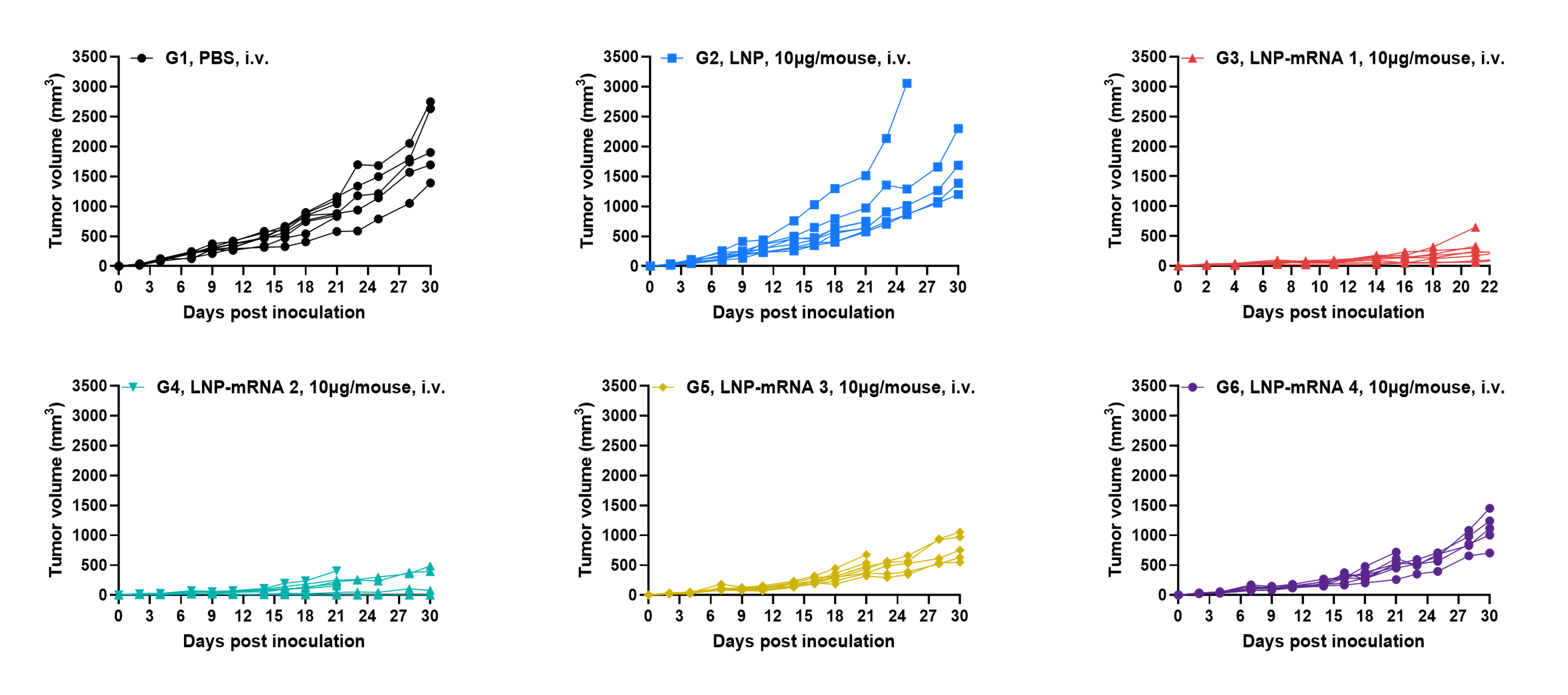
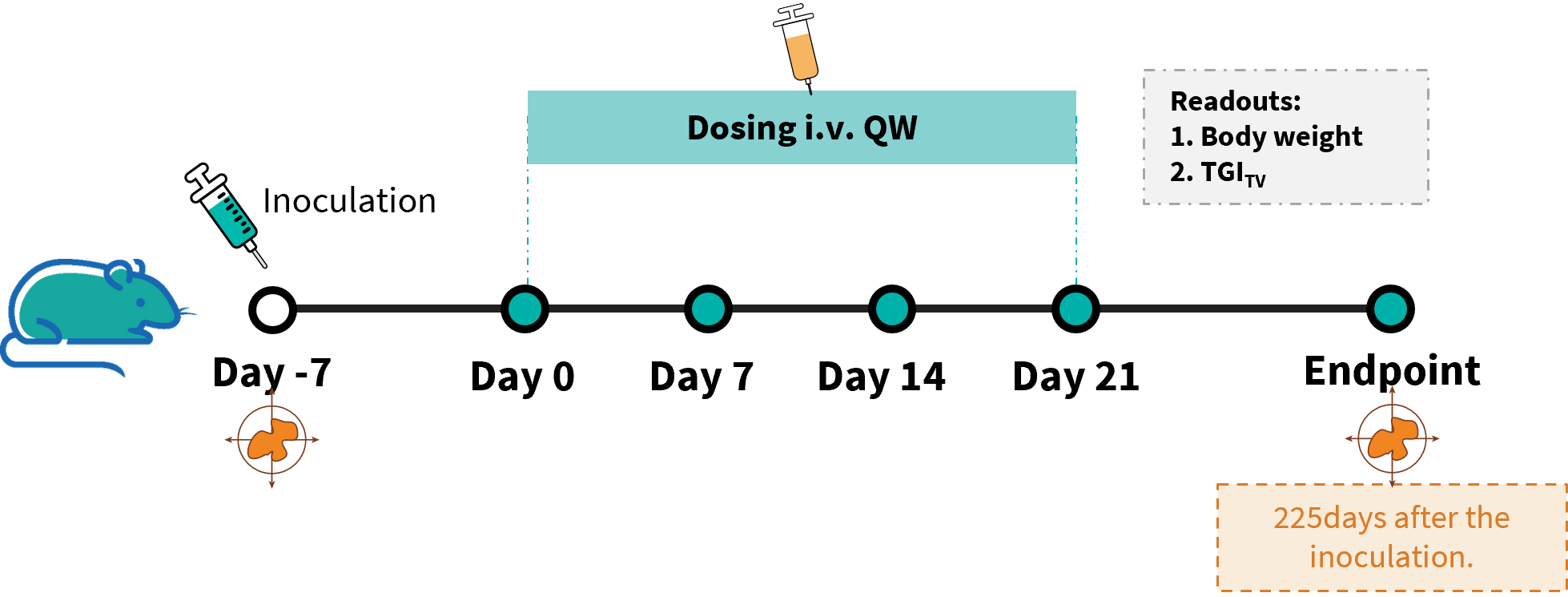
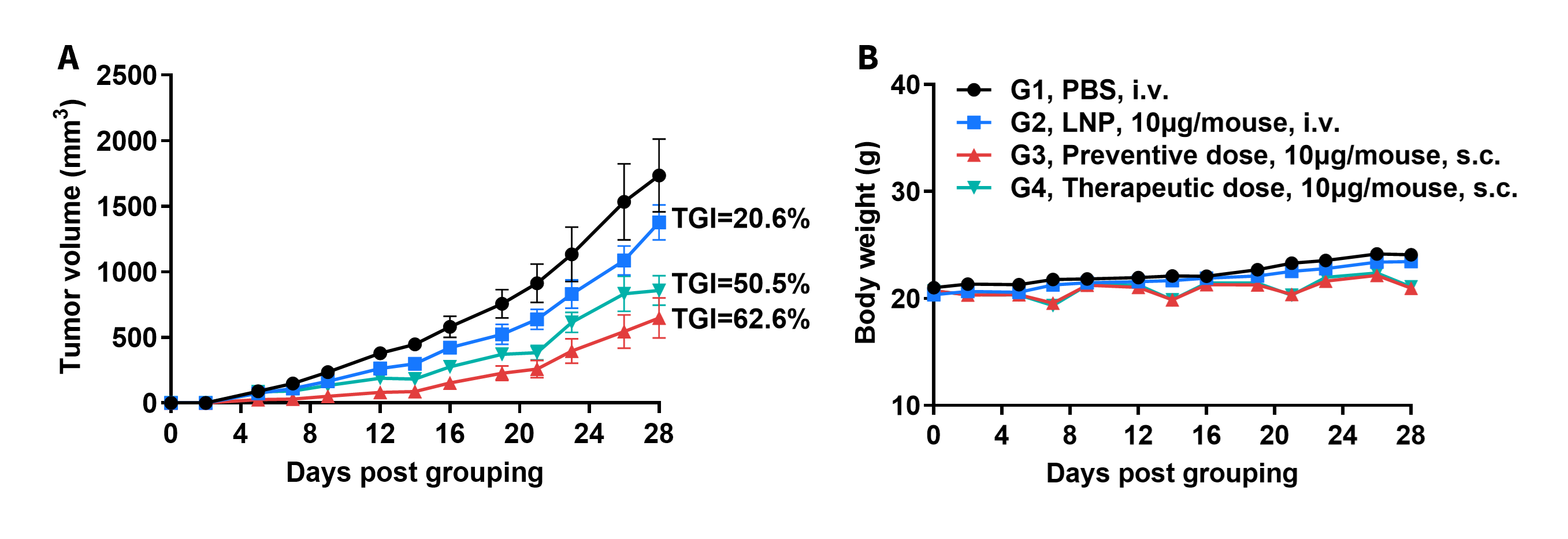
Antitumor activity of HPV16 E6/E7 LNP mRNA mRNA vaccine against syngeneic tumors. (A) Tumor growth curves. (B) Body weight changes during treatment. (C) Tumor cells growth of individual mouse. These results demonstrate that B-HLA-A2.1 mice provide a powerful preclinical model for in vivo evaluation of LNP-mRNA vaccines.
The overage of this tumor model is 40%.
* When publishing results obtained using this animal model, please acknowledge the source as follows: The animal model [B-HLA-A2.1 mice] (Cat# 110110) was purchased from Biocytogen.